Agentic Scheduling & MCP Initiative
Search and discovery are shifting from links to answers — and increasingly, to autonomous agents that can book appointments directly on a user's behalf. As Product Manager, I'm leading OhioHealth's initiative to prepare our digital scheduling experience for this shift, building the technical foundation and cross-team strategy for AI agents like Claude to interact directly with our systems.
Challenge / Problem
AI agents can already navigate our website and attempt to schedule appointments, but there's no dedicated interface between agents and our systems — every integration would otherwise require custom, one-off work per AI platform. Meanwhile, our AI visibility strategy relied on unstructured page content, giving AI agents only low-confidence, inconsistent access to information like insurance acceptance and provider availability.
What We Did
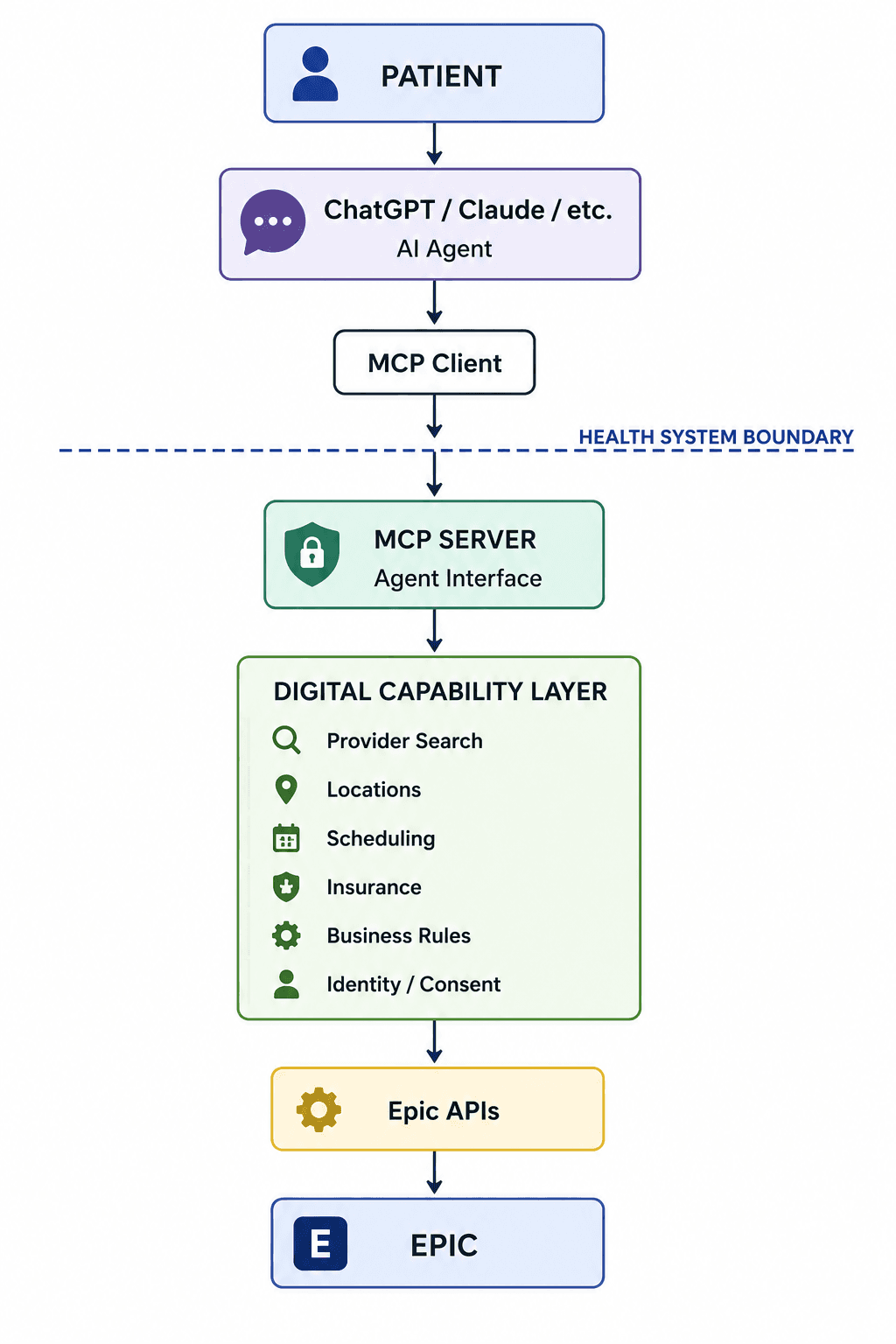
I designed and proposed a customized MCP (Model Context Protocol) server paired with a standardized capabilities agent that exposes core scheduling actions — get_providers, get_location, find_available_appointment, book_appointment — through one reusable interface that any AI agent can discover and invoke, rather than building custom integrations per platform. In parallel, I partnered with Digital Marketing's AI Visibility team, applying MCP expertise from my Claude Certified Architect training and hands-on work at Bold Crow, to reposition the MCP server as an authoritative, structured knowledge and transaction interface — replacing reliance on AI agents having to interpret raw web pages.
Expected Outcomes (in progress)
- A single, reusable interface for any AI agent (e.g., Claude) to safely discover and invoke OhioHealth's scheduling capabilities
- Reduced integration complexity — no custom build required per AI platform
- Higher-confidence, more trustworthy responses from conversational AI platforms
- Positions OhioHealth ahead of the shift toward agent-driven healthcare discovery and booking